

It’s always welcome to see a Terence Rattigan play on the stage, and Summer 1954, currently on a tour of UK theatres, presents two examples in Table Number Seven (the second half of Separate Tables) and The Browning Version. It is an interesting pairing directed by James Dacre and teams a rarely revived piece with one of the staples of the canon.
Nathaniel Parker and Siân Phillips are the top-billed actors, with Parker playing both Major Pollock in Table Number Seven and Andrew Crocker-Harris in The Browning Version. Phillips appears in the first play, as the peevish, snobbish and demanding Mrs Railton-Bell.
This is a clever and skilled portrayal of a woman who loves to dominate and humilate others, including her shy and reserved daughter, Sybil (Alexandra Dowling, who convinces as a someone always held back from action and emotion).
Pollock is a fantasist and repressed homosexual, the latter trait viewed as deviant and treated as criminal in the 1950s. When his misdemeanour of “importuning men on the Esplanade” is recounted in the local newspaper, Mrs Railton-Bell can hardly wait to become judge and jury and force him out of the Bournemouth hotel that has been his home for four years.
As originally performed, Rattigan had to redact this aspect of the Major’s character to appease the Lord Chamberlain’s theatre censor, but Dacre has elected to restore it, and it adds great feeling to both script and Parker’s performance.
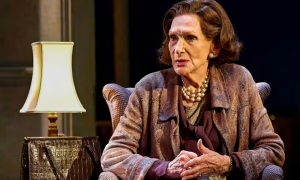
I liked some of the minor characters including Richenda Carey’s salty Miss Meacham and Pamela Miles’s Lady Matheson, the types of ladies of a certain status perhaps left to some financial misfortune or family neglect.
Mike Britton’s revolving set is focused on the dining room and the immediate exterior, but offers a sense of what is happening elsewhere, while Valgeir Sigurdsson provides an unobtrusive but deeply effective score.
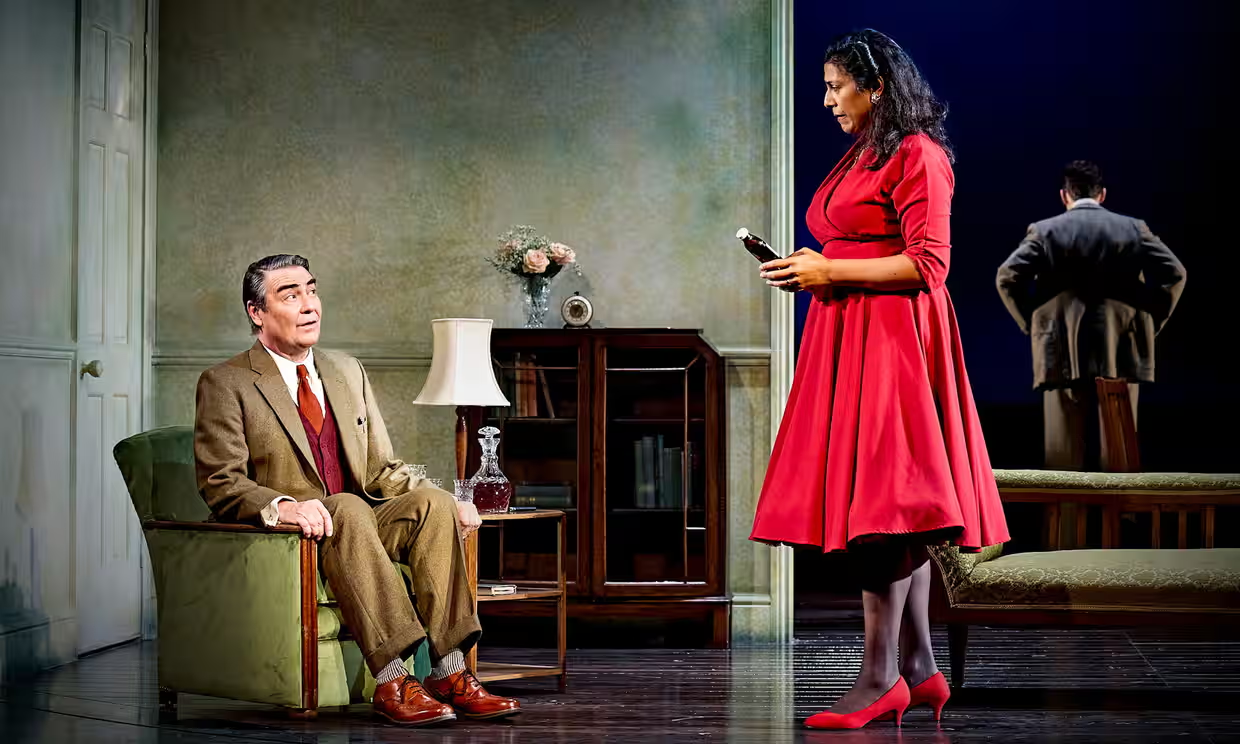
In The Browning Version, Parker plays a schoolmaster forced to retire for health reasons just short of becoming eligible for a pension. His wife (Lolita Chakrabarti) regards him a bore, lacking ambition and drive, and has been enjoying an affair with his younger colleague, Frank Hunter (Jeremy Neumark Jones).
Chakrabarti, dressed in flame red, is sharp, cruel, and sensual. You sense that intimacy between her and her husband died years ago, if it was ever there. As a teacher, Crocker-Harris is seen as a safe pair of hands but mocked by both his pupils and even the headmaster, who refers to him behind closed doors as “the Himmler of the lower fifth”.
It’s a remark carelessly revealed by the young man who will become his successor in both flat and classroom, not intended to hurt but just as wounding as any slight by the unfaithful wife. Into this cauldron of challenges, young Taplow (Bertie Hawes), a pupil, brings a gift of a copy of a translation of Aeschylus’s Agamemnon: The Browning Version.
Originally presented in a double-bill with the comedy Harlequinade, The Browning Version is a touching examination of loneliness, career diligence, and the small moments that can lift or crush a fellow human being. Simon Coates as headmaster Dr Frobisher is perhaps a kinder counterpart of Table Number Seven‘s Mrs Railton-Bell, but is just as calculating in knowingly causing harm.
The pension Crocker-Harris is denied was, after all, granted to another master who had been so useful for the cause of rugby at the school. A crusty classicist who provides the school timetable can hardly be accorded the same consideration.
This was a fascinating pair of plays. Table Number Seven is usually paired with the first half of Separate Tables, Table By The Window. However, in this case we don’t need the back story of the older ladies and as Major Pollock does not appear in the accompanying Table play, you can easily do without it.
I have seen The Browning Version paired with The Winslow Boy, as well as with JM Barrie’s The Twelve Pound Look. it’s always a welcome play to revisit, and in setting it second in this current bill, the play will leave you both thinking about how we treat others and moved by Rattigan’s depiction of the human condition.
Often dismissed as “old-fashioned”, Rattigan’s work is enjoying something of a renaissance, with the upcoming West End production of The Deep Blue Sea. I heartily recommend you catch this double bill on tour to enjoy an excellent interpretation of a mid-century master at work.
5 stars.
Summer 1954 is at Richmond Theatre until 1 Feb, with further dates at Cheltenham Everyman (3-8 Feb) and Oxford Playhouse (11-15 Feb).
Image credit: Manuel Harlan