

Arthur Miller’s searing family drama The Price comes to the Marylebone Theatre in a powerful new production starring two-time Olivier Award-winning Henry Goodman, Faye Castelow, Elliot Cowan nd John Hopkins. In today’s interview, director Jonathan Munby tells us more about the play and why it remains popular today.
On the eve of selling their late father’s possessions, two estranged brothers meet in a cluttered New York attic for the first time in years. What begins as a simple transaction becomes a fierce emotional reckoning, as decades of resentment, sacrifice and buried truth erupt into the open.
Where: Marylebone Theatre
When: 17 Apr-7 Jun 2026
Ticket link: https://www.marylebonetheatre.com/productions/the-price
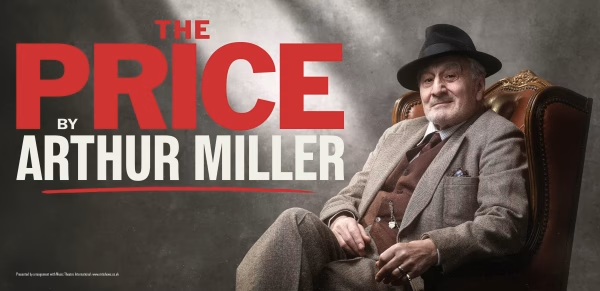
You are directing a new revival of Arthur Miller’s The Price at the Marylebone Theatre. Why does this play still have contemporary relevance?
It’s a play I’ve loved for a long time. I first saw it in the West End, and it stayed with me, as the best plays do. I’m always drawn to works that examine fathers and sons, that interrogate family relationships, and The Price does that with extraordinary precision.
It feels profoundly relevant now. We live in a world where the pursuit of material success can obscure deeper questions of personal fulfilment and human connection. Families are still grappling with the legacies of sacrifice, with the tension between duty and self-realisation, and with the often unspoken burdens passed from one generation to the next. Miller reminds us that happiness cannot be measured in possessions or professional success, and that the unresolved debts of the past—emotional as much as financial—always return to be reckoned with.
This production will invite audiences not only to witness a family confronting its past, but to reflect on the choices, compromises and inheritance that shape their own lives. Miller was writing the play during the Vietnam War, at a time when America was wrestling with questions of responsibility and consequence. As we rehearse now, those questions feel no less urgent. We need Miller – we need him because he asks the difficult questions society often avoids.
I recall seeing your powerful productions of King Lear and The Merchant of Venice. Does The Price offer the same scope to draw out issues around the familial and the community?
Yes, absolutely. Arthur Miller is one of the great dramatists of the human condition. He has an extraordinary understanding of how people behave, of what drives them, and of how they justify their choices. The more we work on the play, the more we uncover just how exact and unsparing his writing is.
As with The Merchant of Venice, there is also a Jewish character at the centre of the play in Solomon, who carries with him a history of prejudice and survival. That perspective brings both humour and resilience, but also a deep understanding of what it means to endure. Miller’s plays, like Shakespeare’s, move between the personal and the societal—they explore intimate relationships while also speaking to the wider structures that shape them. That combination gives The Price a remarkable scope.
You have Henry Goodman leading your cast. What might we expect from his interpretation of Solomon, the dealer?
Henry is one of our great actors, and this is a role that suits him beautifully. It was like it was written for him. At the centre of the play stands Solomon, the elderly furniture dealer—a character of wit, humanity and hard-earned wisdom.
Henry brings both humour and gravitas to the role. Solomon is, in many ways, the play’s mediator and truth-teller. He provokes, he observes, and ultimately he reveals things that the two brothers would rather avoid. Through him, the play balances on a knife-edge between tragic confrontation and comic absurdity.
The Price offers a darkly comic yet poignant look at two brothers in Manhattan. What attracted you to the play in particular, and why restage it now?
Further to my answer above, what draws me to the play is its clarity and its honesty. My approach has been to honour Miller’s specificity. This is a story deeply rooted in post-Depression America, and that historical context is essential—it shapes the choices, the resentments, and the emotional lives of the characters.
At the same time, the play resonates far beyond its period. The questions Miller asks are timeless. What is the true cost of our choices? What price do we pay for survival, for ambition, for loyalty, for betrayal, for love?
In the relationship between Victor and Walter Franz, there is a profound exploration of fathers and sons, of inheritance, and of the wounds that can pass between generations. That tension feels as alive now as ever. Restaging the play now allows us to encounter those questions afresh, in the context of our own moment.
Do you think there is still a place for literature looking at ‘the American dream’?
Absolutely. The idea of the American Dream—of success, self-determination, and upward mobility—remains one of the most powerful and enduring narratives of the modern world. But what writers like Miller do is interrogate that dream. They ask what it costs, who it serves, and what is left behind in its pursuit.
In The Price, we see the aftermath of that dream—the compromises, the sacrifices, and the disillusionment that can accompany it. It’s not a rejection of the dream, but a humanising of it. It reminds us that behind every notion of success are real lives, real relationships, and often unresolved tensions.
That’s why these stories still matter. They allow us to examine not only the dream itself, but the price we are willing to pay for it.